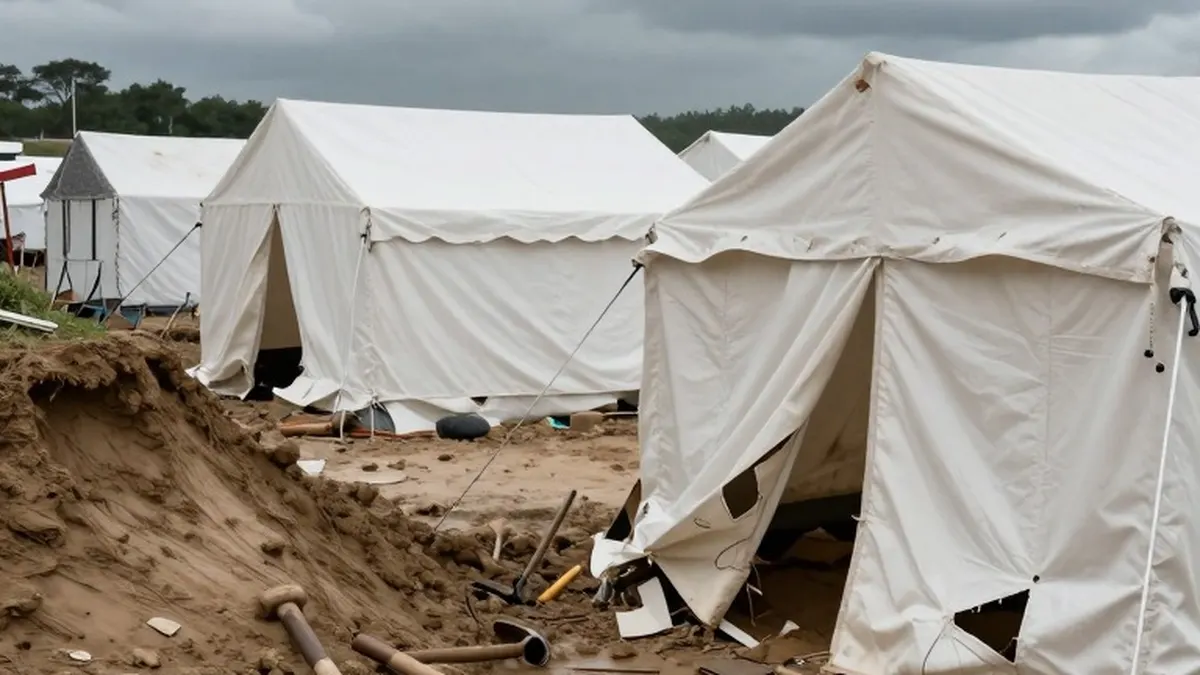
A deadly collapse of a sand embankment in central Gaza has killed a woman and three small children, underscoring the severe risks facing displaced Palestinians as the rainy winter season begins. The incident occurred late on Sunday when heavy rain washed away a rocky sandbank adjacent to a camp for displaced families located south of Deir al-Balah.
Medical responders reported that the woman, along with two of her children aged eight and six, lost their lives in the accident. A fourth child, who was four years old, was also killed, while six other individuals sustained injuries. The sudden failure of the natural barrier trapped residents under a mound of sand and rock.
Video footage verified by Reuters showed residents working frantically to clear the debris. They used hammers to break apart large sandy rocks and shovels to remove sand, utilizing flashlights to search for people trapped beneath the rubble. The scene depicted the urgent efforts of the community to rescue survivors from the collapsed site.
Amal Al-Zein, a 35-year-old relative of the victims, expressed the collective grief of the community. She stated that those who did not die from bombs and missiles are now dying from collapsing buildings and sand. Another witness, Sohaib Abu Darbali, described the sound of the embankment collapsing as similar to an explosion. He noted that three tents were completely covered, leaving people trapped under the rubble where they could not be seen.
The vast majority of Gaza's two million residents currently live in tent encampments or the ruins of bombed-out buildings. Reconstruction has yet to begin following Israel's two-year military assault, which was launched after the 2023 Hamas attacks on southern Israel. For many inhabitants, this marks the fourth consecutive winter in which they must contend with floodwater overtaking their shelters and soaking their few belongings.
Local authorities indicated that at least 70,000 tents were flooded in the initial hours after heavy rain began on Saturday. The United Nations Office for the Co-ordination of Humanitarian Affairs reported that humanitarian partners received appeals from over 26,000 households. These families reported damage to their shelters or belongings following the weekend rainstorms.
Mahmoud Basal, the spokesman for Gaza's civil defence service, explained that people often position their tents next to sandbanks in the belief that these structures would provide protection. However, he emphasized that tents offer little defense against rain or heat, stating that the only true solution is reconstruction. A U.S.-brokered ceasefire last year called for eventual reconstruction, but progress has been slow due to disagreements over Hamas disarmament and troop withdrawals.
Save the Children warned of another critical winter season, describing the flooding and its impact as entirely foreseeable. Ahmad Alhendawi, the group's regional director, noted that while families slept, water flooded their tents and engulfed entire camps. He highlighted that children shivered in the cold without proper winter clothing and that families lost the few remaining belongings they possessed.
The non-governmental organization stated that basic items continue to be restricted from entering the territory. Alhendawi pointed out that tents, shelter kits, and fuel are waiting at Gaza's borders while children sleep in floodwater. He described the situation as a choice made by Israeli authorities blocking entry, with children paying the price for the failure of the ceasefire to protect them.