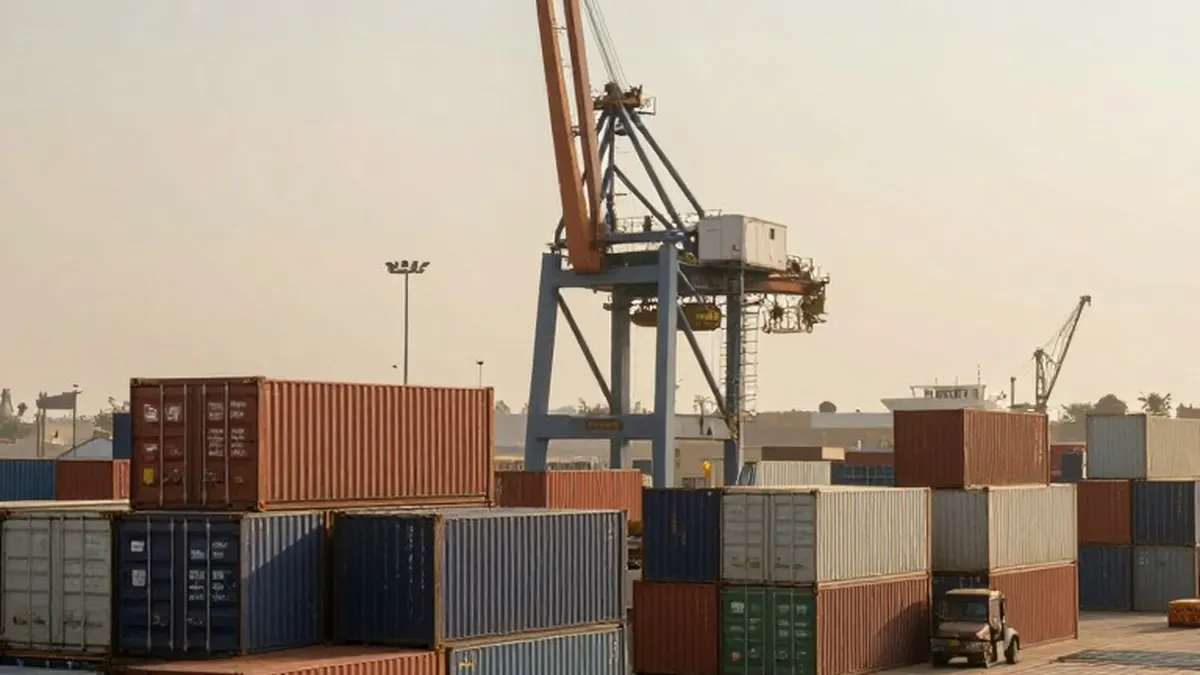
Yemen's internationally recognized authorities have introduced new regulations designed to increase financial oversight of goods entering ports under Houthi control. A decision issued by the National Committee for Regulating and Financing Imports requires that all customs duties, taxes, and other mandated government revenues be settled in advance for imports destined for these areas. This directive was circulated by the Aden Chamber of Commerce and Industry earlier this week.
The new measures condition the processing of foreign exchange transactions and related international transfers on proof that all applicable charges have been paid in full. While the government aims to streamline revenue collection, critics argue that these requirements could impose an additional financial burden on businesses. Many importers operate within a poverty-stricken economy where capital is already scarce, making upfront payments a significant hurdle.
Wafiq Saleh, an economic journalist in Yemen, discussed the impact of these changes on the Yemen Youth TV Channel last week. He noted that the limited quantity of imports currently allowed to reach the besieged city of Taiz is insufficient to meet the basic needs of its residents. Saleh described the country as slipping into a war-driven economy, characterized by inflated prices for essential goods in the black market.
In a post on social media, Saleh characterized the government's new measures as a significant economic tool for the Central Bank and the National Committee for Import Financing. He stated that traders and importers who attempt to bypass this mechanism will face difficulties in covering letters of credit for goods imported from abroad. According to Saleh, the Central Bank of Yemen in Aden remains the authorized entity for covering these letters of credit and communicating with regional correspondent and intermediary banks.
Saleh emphasized that no commercial or banking entity will be able to access the international financial system outside of the official monetary authorities. This consolidation of power over financial flows is seen as a method to enforce compliance with the new tax and duty requirements. The move effectively centralizes control over cross-border trade payments within the official government framework.
Since the Houthis captured Sanaa in 2014, the group has established its own revenue collection systems. These include taxes, customs duties, zakat, and other levies. The independent Yemeni research and policy institution Mokha Center for Strategic Studies has documented these parallel financial structures. The center highlights how these mechanisms have become a primary source of funding for the group's operations and governance.
A report published by the Mokha Center in July estimated that the Houthis' parallel economy accounts for approximately $2.5 billion annually in direct and indirect financial resources and costs. The breakdown of these figures includes around $800 million from taxes and customs, and $600 million from additional fees and levies. The report also noted that $300 million comes from cash and in-kind contributions to the war effort, while $100 million is generated through mobilization events.
Businesses operating in Houthi-controlled areas bear a significant share of the financial strain, with the Mokha Center estimating that they face an additional $700 million in indirect costs. These burdens are layered on top of the direct taxes and fees, creating a complex web of financial obligations for the private sector. The new government rules aim to address some of these inefficiencies by ensuring that revenue is collected before goods are cleared for entry.
The financial maneuvering by Yemeni authorities comes amid ongoing diplomatic efforts to end the conflict. On Thursday, the Wall Street Journal reported that the Houthis have demanded $51 billion from Saudi Arabia as compensation for years of airstrikes and a prolonged blockade. In addition to this monetary sum, the group seeks formal recognition as Yemen's rulers in exchange for ending hostilities.
Saudi Arabia has faced repeated attacks from Iran and the Iran-backed Houthis since the United States and Israel launched strikes against Iran on February 28. In response to these threats, Riyadh has sought to strengthen its regional defense partnerships. The kingdom signed the Mecca Joint Defense Agreement with Turkey and Pakistan in August, and on Wednesday, it signed a separate defense cooperation agreement with Syria.