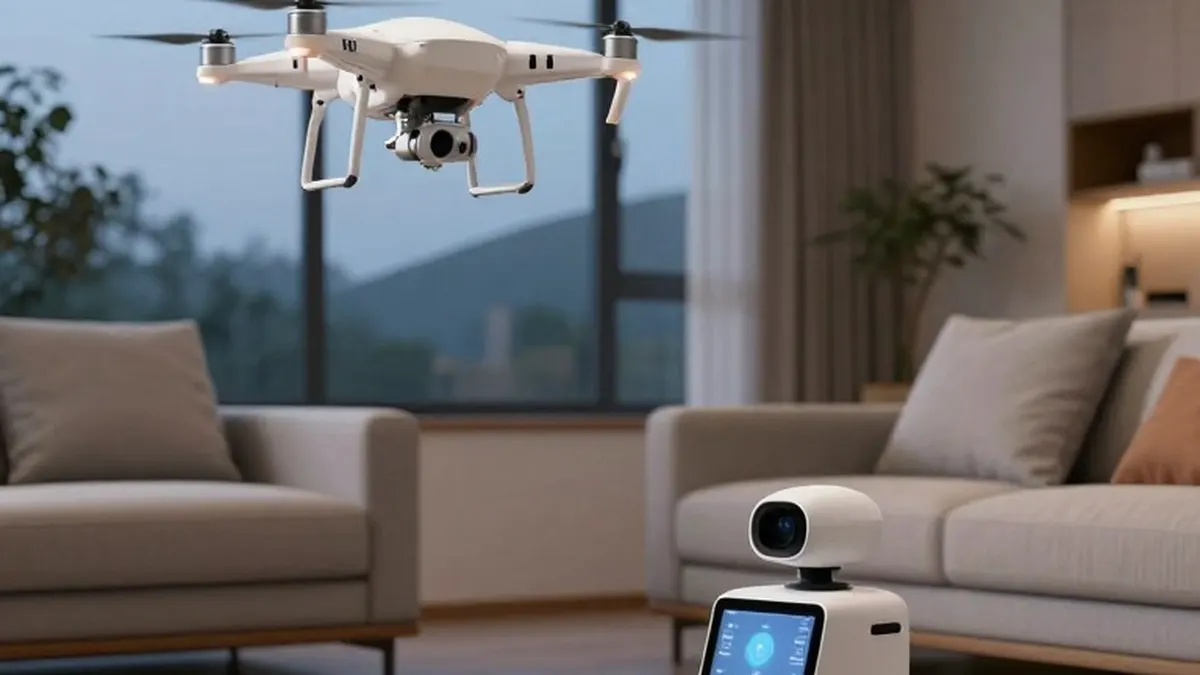
Amazon's Ring division has announced two new autonomous security devices designed to monitor homes and commercial spaces. The company revealed the Ring Drone Cam and the Ring Rover Cam on Tuesday, marking a significant expansion in its product lineup beyond traditional stationary cameras and doorbells.
The Ring Drone Cam is priced at $250 and functions as a flying security camera. It is capable of moving from room to room, including ascending to upper floors, and can capture video footage in both day and night conditions. When a motion sensor or alarm is triggered on connected devices such as doors or windows, the drone follows a pre-set path to investigate the source of the activity. Users also have the option to deploy the device manually at any time.
Ring CEO Jamie Siminoff demonstrated the device in New York on Monday. He described the drone as both a monitoring tool and a deterrent against crime. The device features built-in LED lights that can be used to spot an intruder. Siminoff noted that the sight of a flying device with spotlights moving across a window at night would likely discourage potential burglars from entering a property.
The drone is roughly the size of a textbook and utilizes two plastic-encased propellers that produce a noticeable buzzing sound during flight. It can operate for up to eight minutes before automatically returning to its charging dock. This design allows for flexible surveillance without the need for multiple fixed cameras in different locations.
The second product, the Ring Rover Cam, is priced at $1,000 and is designed for business environments such as offices and warehouses. This device repurposes hardware from Amazon's Astro home robot, which was previously released in 2021. Ring described the Rover Cam as a purpose-built security robot that leverages the best features of the Astro platform.
The Rover Cam features a display mounted on a two-wheeled base, along with an extendable periscope camera. It includes a built-in siren, two-way audio capabilities, and a light tower that projects light onto the ceiling to help users track its position within a room. Siminoff stated that these devices allow users to monitor multiple areas with a single unit, addressing the common preference for indoor cameras without the desire to have them installed in every corner of a home.
Ring has addressed previous privacy concerns by stating that privacy is the default mode for both new devices. Both the drone and the robot flash an LED light when they are actively recording. The company has been mindful of these issues following past scrutiny related to its partnerships with police departments and the cancellation of an integration with Flock Safety earlier this year.
Siminoff explained that the drone was first previewed in 2020 under the name Always Home Cam. He said the company delayed the release to perfect the design, sensors, and data processing capabilities. Regarding outdoor use, the CEO noted that the drone is restricted to indoor environments due to Federal Aviation Administration regulations, which generally require a pilot's line of sight for drone operations.
The company has implemented software guardrails to prevent the drone from flying outside. Siminoff confirmed that customers have been advised to keep the device indoors to comply with these legal requirements. The Ring Drone Cam is scheduled to ship in the United States on January 27, pending approval from the Federal Communications Commission.
The Ring Rover Cam will begin shipping to users on December 16. These launches represent a continued push by Ring to grow its presence in the smart home market, which Grand View Research estimates will exceed $200 billion in sales this year. The new devices position Ring as a competitor to other major tech firms, including Apple and Google, in the expanding field of automated home security.