Britain has unveiled its first national public preparedness campaign in almost half a century, urging households to be ready to look after themselves for 72 hours in an emergency, whether a climate crisis, cyber disruptions or threats from hostile states.
The "Be Ready" guide was launched last month, exactly one week after the head of the British Army, Gen. Sir Roland Walker, addressed some 700 soldiers at the country's biggest garrison in northern England. The "business of soldiering" had returned to the national psyche, he told members of the light, high-readiness global response force, adding that anyone following world affairs would recognize the "extreme jeopardy." Political leaders, he said, "will start to have a frank conversation with the citizens of this country about just what is going on, and where the risk lies."
The last comparable effort came in 1980, at the peak of the Cold War, when the "Protect and Survive" broadcasts and booklets advised Britons on preparing for a nuclear attack, including hiding under a heavy table and how to store a dead body in the house for five days. The campaign backfired and was ridiculed, leaving many convinced that preparation was pointless because survival would be futile.
Lucy Easthope, a global disaster recovery specialist who has advised on emergencies from the Novichok poisonings in Salisbury, England, to the 2004 Indian Ocean tsunami and 9/11, said emergency planners have wanted such a campaign for a very long time, and that the public wants reassurance rather than negative messaging. "Ancient DNA, by that I mean 30 years ago, is being reawoken," she told CBC News. "I'm really pleased in the U.K. we haven't resorted to fear messaging."
Britain is not alone. France, Ireland, Sweden, Norway, Germany and Poland have all recently introduced or updated emergency guidance, and Ottawa has reiterated its longstanding advice. Sweden advises citizens to manage for seven days and Germany up to 10, while the U.K., like Canada, has settled on three days off-grid. But Britain faces a cultural hurdle: the word "preparedness" is not even in most Britons' vocabulary, and the country has largely relied on community resilience to short-term disruptions rather than self-sufficiency.
Skepticism remains common. Nyari Matebwe, a family physician in Hertfordshire, north of London, said her first reaction was to roll her eyes and ignore the guidance. "I feel like it's scaremonger-y, or the skeptic in me thinks maybe they're hiding something from us," she said. Still, suspected hacking attacks on supermarket freezers in multiple European countries, attempts to raise temperatures in French medical fridges holding critical blood donation stocks, and recent airplane bomb hoaxes have made her think about it more, and her teenage daughter is pushing her to take the message seriously.
Officials insist the threats are real. Richard Horne, head of the National Cyber Security Centre, part of the signals agency GCHQ, told CBC News that "this is a moment of urgency." The NCSC says AI-powered malicious software is "highly likely" to be used in hacking attacks against British power stations, airports and hospitals within two years, and Horne said military networks face sustained and persistent attempts to penetrate systems, including Russian hybrid warfare campaigns. At home, he advised keeping devices up to date, using passkeys and not unnecessarily connecting devices. In October, Defence Secretary Wes Streeting warned the country needs to be "ready for war in 1,000 days," flagging potential Russian aggression. "To prevent the worst, we have to prepare for it," he said.
Some dismiss the campaign as another example of the "nanny state." Others point to culture. Luis Martinez Arnal, an IT professional from Spain based in London, said his Mexican wife prepares automatically, having grown up in a country prone to earthquakes. "But in the U.K., hard times have been forgotten," he said, adding that the accessibility of everything "psychologically is making us feel more comfortable." Recent cyberattacks have also raised questions about how anyone could stay connected if the internet went down, questions not easily answered as Britain plans to switch all copper-wire landline phones to internet-only use from the end of January 2027.
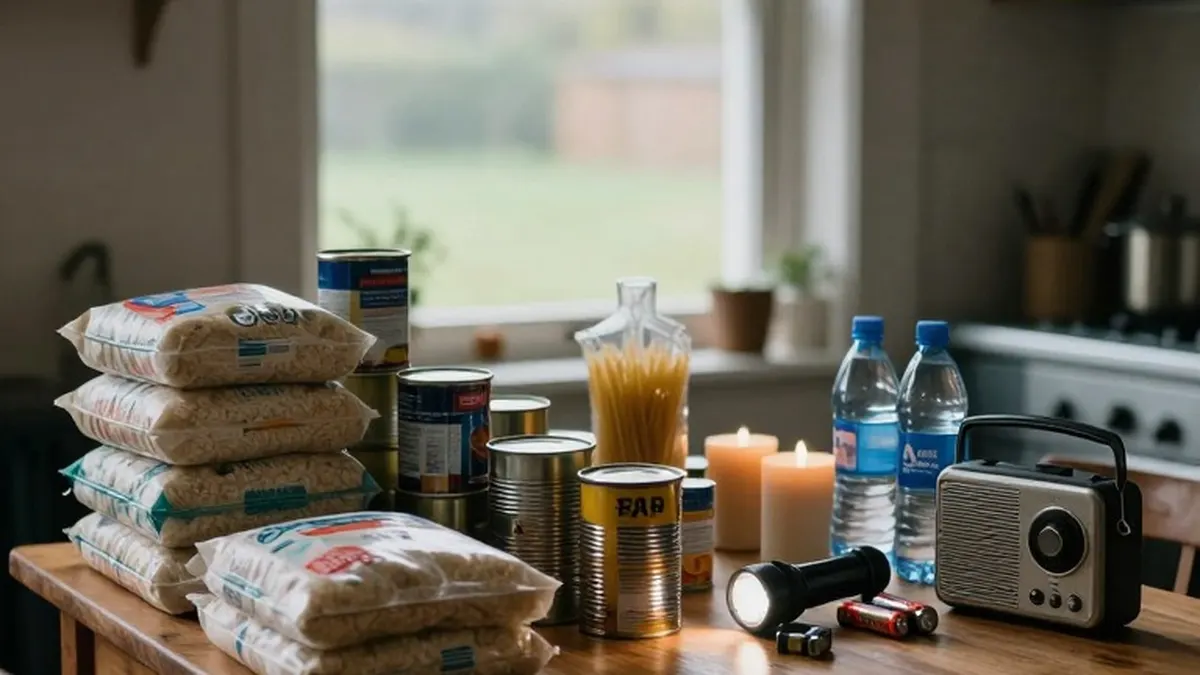
Some are already converted. Preyal Shah, a working mother from Harrow in northwest London, said she now keeps 10 kilograms of rice, five kilograms of pasta and multiple cases of tinned food, and is stockpiling newspapers to light a coal-burning stove. Reena Patel, a lawyer from north London, cited "so many competing crises," including war in Europe with Russia's full-scale invasion of Ukraine, and plans to buy a wind-up radio and water purification filters. "The only thing I have in my control is to try to be a little bit prepared," she said.