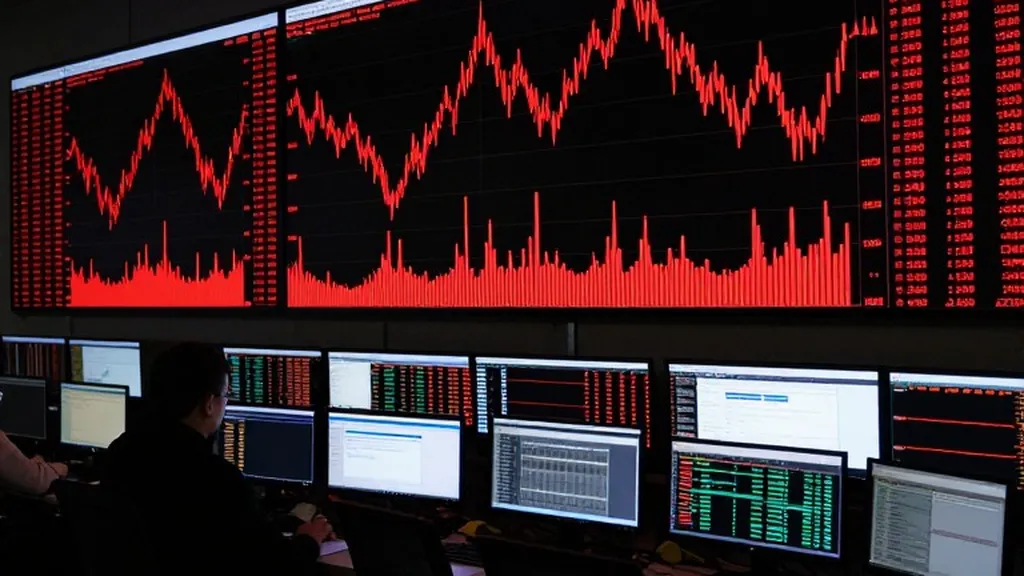
Wall Street closed on Thursday with a sharp decline as a surge in volatility indicators signaled a sudden shift in investor sentiment. The Cboe Volatility Index, widely known as the market's fear gauge, jumped as much as 5.7 points to above 28 roughly 90 minutes after the opening bell, according to data from CNBC. This marked the highest reading for the index since March 31, 2026, the day after the S&P 500 bottomed during the Iran war tensions. The Guardian reported that the VIX rose 61 percent on the day, with the move from its low to its high spanning more than 11 points, the biggest one-day move since April 9.
The spike in volatility coincided with an unprecedented frenzy in the options market. By midday, nearly 800,000 VIX call options had traded, a volume that was 3.5 times the 30-day average, according to Cboe data cited by CNBC. This activity suggests that traders were aggressively hedging against further downside risk or betting on continued turbulence. The intense trading volume underscored the urgency with which market participants sought to protect their portfolios from the unfolding sell-off.
Amid the volatility, talk of a hedge fund liquidation gained traction among traders, pointing to a potential momentum unwind as a key driver of the decline. Noel Smith, an options trader quoted by CNBC, described the market action as a liquidation. He stated that his data suggested de-risking, but his gut indicated that the event could create a dip-buying opportunity. Smith noted that oil and interest rates were relatively unchanged and emphasized that the tape looked like a liquidation, which aligned with what he was hearing regarding a specific hedge fund.
As stocks fell, investors executed a flight into Treasuries, seeking safety in government bonds. The 10-year Treasury yield fell to 4.83 percent, its lowest level since September, according to The New York Times. This move reflected a broader preference for fixed-income assets as equities became more volatile. The shift into bonds highlighted the defensive posture adopted by many institutional investors and retail traders facing uncertainty.
The broader market indices suffered significant losses on the day. The Dow Jones Industrial Average fell more than 1,800 points, a drop of 3.4 percent, to close at 51,868, erasing the gains made on Wednesday, according to The Guardian. The S&P 500 fell 4.3 percent, marking its worst day since April 2025, when President Trump announced sweeping global tariffs. The Nasdaq Composite experienced the steepest decline, falling 5.5 percent, its worst day in 18 months, and closed more than 11 percent below its record set last month, according to The Guardian and The New York Times.
The decline was driven by concerns over the artificial intelligence trade and the impact of recent midterm election results. Democrats swept the House and Senate in Tuesday's elections, with candidates campaigning on slowing the spread of data centers and AI, according to CNBC. Investors are weighing whether tighter state-level restrictions could slow data center construction, pressuring companies tied to the AI trade. This concern was compounded by broader worries that the huge sums being spent on AI may not pay off, leading to fears that AI shares may be in a bubble.
Neil Wilson, an investor strategist at Saxo UK, told The Guardian that a complete capitulation-level event was playing out in tech stocks. He expressed fear of a total momentum unwind as Democrats paced the frontier and potentially restricted data center buildout. Wilson noted that while the move looked overdone, the nature of selling everything in this market meant investors needed to look for some stability first. Dan Ives, a tech analyst, added that Democrats taking control, especially over the Senate, would create major hurdles for AI and tech legislation over the next two years.
The tech sector bore the brunt of the selling, with the Magnificent Seven technology companies shedding about $1 trillion in value in the single trading day, according to the BBC. Nvidia fell 9.2 percent, losing more than $400 billion in market value, while the Philadelphia Semiconductor Index fell more than 12 percent. Susannah Streeter, chief investment strategist at Wealth Club, told the BBC that fresh panic over the AI trade had hit Wall Street hard, with fears that vast sums poured into AI infrastructure may not deliver the returns investors have been banking on.
Historical data suggests that such corrections in bull markets are typically short-lived. Gene Goldman, chief investment officer at Cetera Financial Group, told The New York Times that the sell-off had become exaggerated and predicted a recovery. He stated that when there is a correction in a bull market, it is typically short-lived, and while the situation is ugly right now, he believes a bounce back is imminent. Frank Cappelleri, founder of CappThesis, noted to CNBC that the Nasdaq was higher 12 months after the election in all but one of 13 midterm cycles since 1974, though he cautioned that the path can be a volatile one.
The market's reaction underscores the sensitivity of current valuations to political and structural shifts. As the VIX remains elevated and options trading volumes stay high, investors are closely monitoring for signs of stabilization. The interplay between election outcomes, AI infrastructure concerns, and technical trading patterns has created a complex environment where fear and opportunity coexist. The day's events serve as a reminder of how quickly sentiment can shift in a market heavily weighted toward high-growth technology stocks.