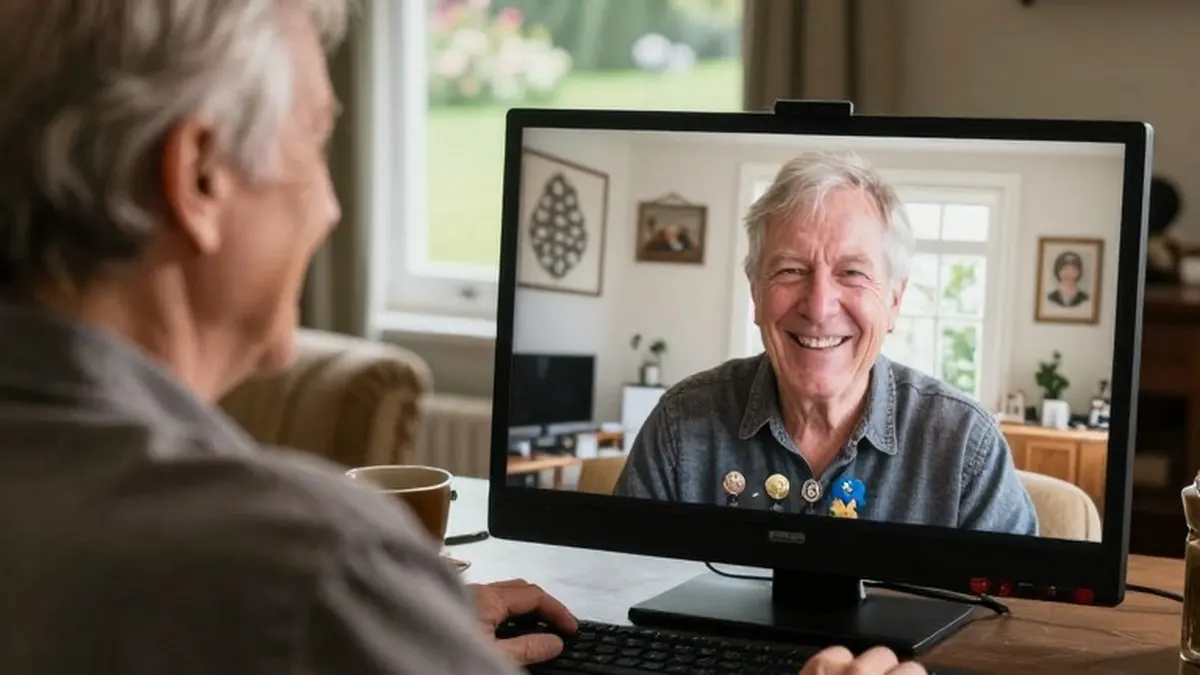
Rod Anderson, an 81-year-old resident of England, received a life-changing phone call earlier this year that resolved a mystery that had haunted him since birth. Anderson learned that his biological father was a Canadian soldier who served in the United Kingdom during the Second World War. The revelation confirmed a family secret that had remained hidden for generations, finally connecting Anderson with relatives on the other side of the Atlantic Ocean.
Anderson was born in 1945 in Farnham, England, to a British mother. For most of his life, he wondered about his father's identity, a question that was compounded by the stigma surrounding children born out of wedlock during the post-war period. "I was knocked down by it all. It was just such a shock," Anderson told CBC News. He noted that while the news was profound, the emotional impact remains significant even now.
The search for Anderson began nearly two decades ago with Bethany Allen, a Canadian woman from New Brunswick. Allen was driven by persistent family rumors that her grandfather, Charles Blakney, had fathered a child in England while serving in the military. Blakney had departed for the UK in 1942 to serve as a motor and driver mechanic with the New Brunswick Rangers, leaving behind his wife and infant daughter in Canada. He returned home in 1945, the same year Anderson was born.
In 2008, Allen requested her grandfather's divorce records from the archives. The documents provided definitive proof that a child had been born in England during the war, turning long-held rumors into fact. However, Allen did not know the identity of the child. Her mother, who had passed away, had asked her to continue the search to ensure their sibling had a good life. Allen described this period as a long and dedicated effort to uncover the truth.
The breakthrough occurred in the spring of 2026 when Allen submitted a DNA test through a U.S.-based company. The results identified Rod Anderson as her half-uncle. Allen immediately contacted Anderson's daughter, Dawn Roberts, in England. Roberts informed her father of the news, and Anderson, who had previously taken a DNA test that failed to identify his father, was initially skeptical. "I thought this is a wind up. It has to be," Anderson recalled. The new test results, however, provided the missing link his earlier attempts had lacked.
Historians note that these wartime connections were often kept secret due to the significant social stigma attached to unwed pregnancies in the 1940s. Jeff Noakes, a Second World War historian at the Canadian War Museum, explained that the blame often fell disproportionately on the mothers. Public attention to the issue was high enough that Canadian military leadership held press conferences to defend their troops' conduct in 1945, particularly in response to concerns raised in Dutch media about Canadian soldiers stationed in the Netherlands.
Anderson has since connected with his 77-year-old half-sister, Barb Lowe, who lives in St. Thomas, Ontario. The siblings speak weekly and share a close bond, noting their similar sense of humor and physical resemblance. Lowe mentioned that Anderson resembles their late father, who died in 1987. The connection has been deeply emotional for Lowe, who has lost other siblings and views Anderson as a vital part of her family history.
The discovery also revealed a professional coincidence that surprised Anderson. As a child, he lost an arm and an eye in a rail accident. In the 1960s, a government assessment suggested that, due to his injuries, he could not work as a mechanic. Anderson defied this prediction and built a successful career as a motor mechanic, eventually opening his own business. This was the exact profession his Canadian father held during the war.
The family's search may not be entirely complete. The divorce records indicated that Blakney had another child in Britain during the war, a mystery that both sides of the family are now working to solve. Anderson is planning a trip to New Brunswick this summer, bringing his granddaughter with him to meet the extended family. For Anderson, the discovery ensures that his lineage and story will be passed down to future generations.
The reunion highlights the ongoing efforts of families to trace their roots and connect with relatives separated by war and time. As Allen noted, the process demonstrates the power of persistence and modern genetic tools in resolving historical questions. The family remains optimistic about uncovering the rest of their shared history before it is too late.