Daily newspapers close to Iran's Islamic Revolutionary Guard Corps have published lists of potential targets across Europe, following US strikes on Qeshm Island last week and amid growing speculation that the United States could return to open war with Iran.
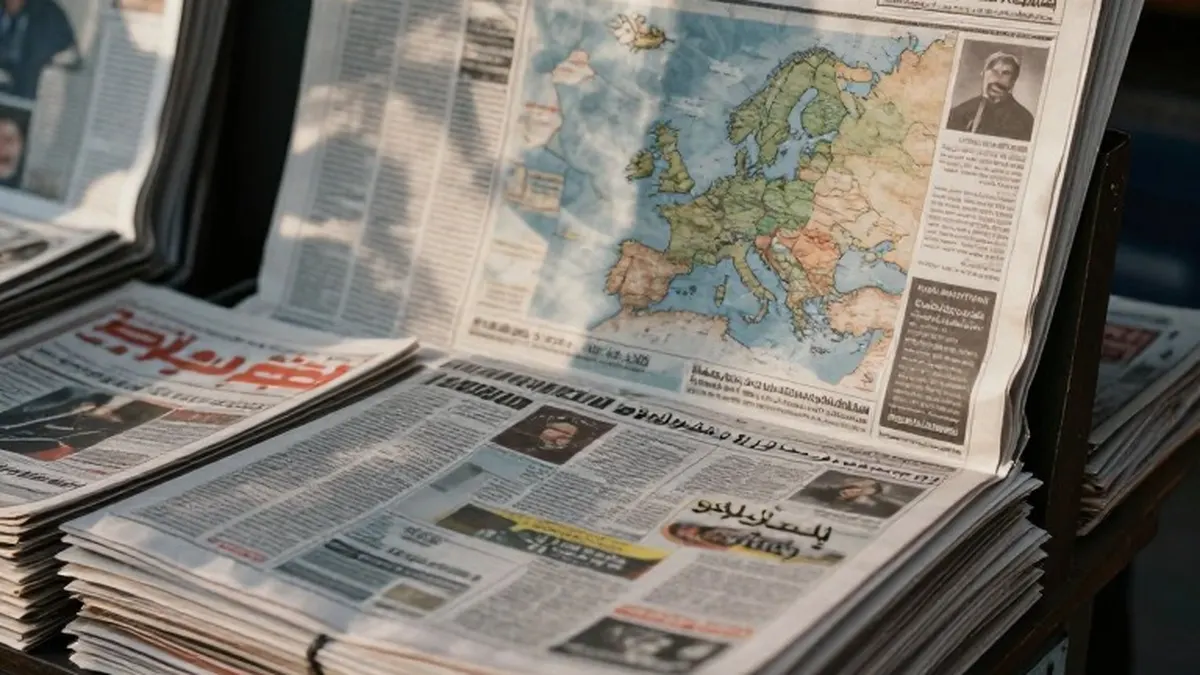
On Tuesday, the Hamshahri daily ran a map of Europe on its front page, marking bases used by US forces in the UK, Germany, France, Italy, Romania, Greece, Albania and Portugal as the "target bank of the Iranian armed forces". The paper described Iran's new military strategy as one "of confrontation without geographical limits", a phrase previously used by Supreme Leader Mojtaba Khamenei, and wrote that "US support centres, air and naval bases, and logistical infrastructure in Europe have been raised as potential targets".
The Kayhan daily, whose editor is appointed by the supreme leader, issued a similar warning. It said that if Washington did not accept Iran's conditions for a peace deal, "the geography of the battle will expand to the heart of Europe and the depth of overseas bases". Kayhan added that Iran's military doctrine towards the US, Israel and their allies had become "more direct and more offensive", and singled out the UK among European countries involved in the war, saying it had played "the most key and prominent role".
The news website Khabar Online, meanwhile, drew parallels between the Republican Party's defeat in the US midterm elections and the 2006 midterms held during the US-led occupation of Iraq. As senior Iranian officials welcomed the result as a blow to President Donald Trump's hawkish policies, the site cautioned that "a change in the congressional majority and opposition to war policies do not necessarily mean an immediate retreat by the president or an end to military operations".
Recalling the Republican defeat under then president George W Bush, the report noted that Washington went on to increase troop numbers in Iraq rather than withdraw. "The expectation of some opponents of the war was that a Democratic victory would pave the way for a rapid withdrawal of US forces from Iraq. But what happened in the following months was the opposite," it said, concluding that "even an anti-war majority in Congress cannot, on its own, stop the government's military course without political unity and the ability to overcome a presidential veto".
Iranian media also covered remarks by Daniel Levy, an Israeli peace negotiator who took part in the 1993 Oslo-B talks, who told BBC Persian that Israel's aim in launching a new war against Iran on 28 February was the collapse of the state, the creation of chaos and the break-up of the country, similar to what happened in Iraq and Syria. "I don't think the Israelis themselves even believed their own propaganda narrative that regime change could be achieved in Iran," he said.
Levy pointed to early war reports about weapons being sent to Iranian Kurdish opposition groups in Iraq, saying the initial idea was to establish a liberated area inside Iran where resources and military forces could be concentrated against the central government. He also described Israel's backing of Reza Pahlavi, the son of Iran's deposed shah, as a temporary strategy. "The Pahlavi family was a useful tool for Israel. A tool for creating chaos. I don't believe they thought the end result would be regime change. I don't even think they considered that a desirable outcome," he said.
On the diplomatic front, the pro-reformist Shargh daily reported that security official Ali Bagheri Kani's recent meetings in Beijing could signal the creation of "a parallel diplomatic path" led by China and Oman, describing the visit as part of Tehran's consultations to assess new initiatives and explore the capacity of influential countries to prevent the crisis from escalating.
The conservative Jame Jam daily framed the same visit as part of Iran's effort to bring Beijing and Moscow on board with its regional policies, alongside mediators such as Qatar and Pakistan, as Tehran manages the war it has faced since February. The paper stressed, however, that statements of support from China and Russia alone could not stop the conflict, and that their effectiveness depended on practical action to prevent US unilateralism in the region.