Paraguay's rightwing president, Santiago Peña, announced his resignation on Thursday following a political and financial crisis that brought down the South American nation's banking system in recent days.
At the heart of the turmoil is Ueno Bank, which during Peña's time in office grew in just a few years from a little-known digital lender into one of the country's biggest banks, saying it counted roughly 60 percent of Paraguay's adult population among its customers.
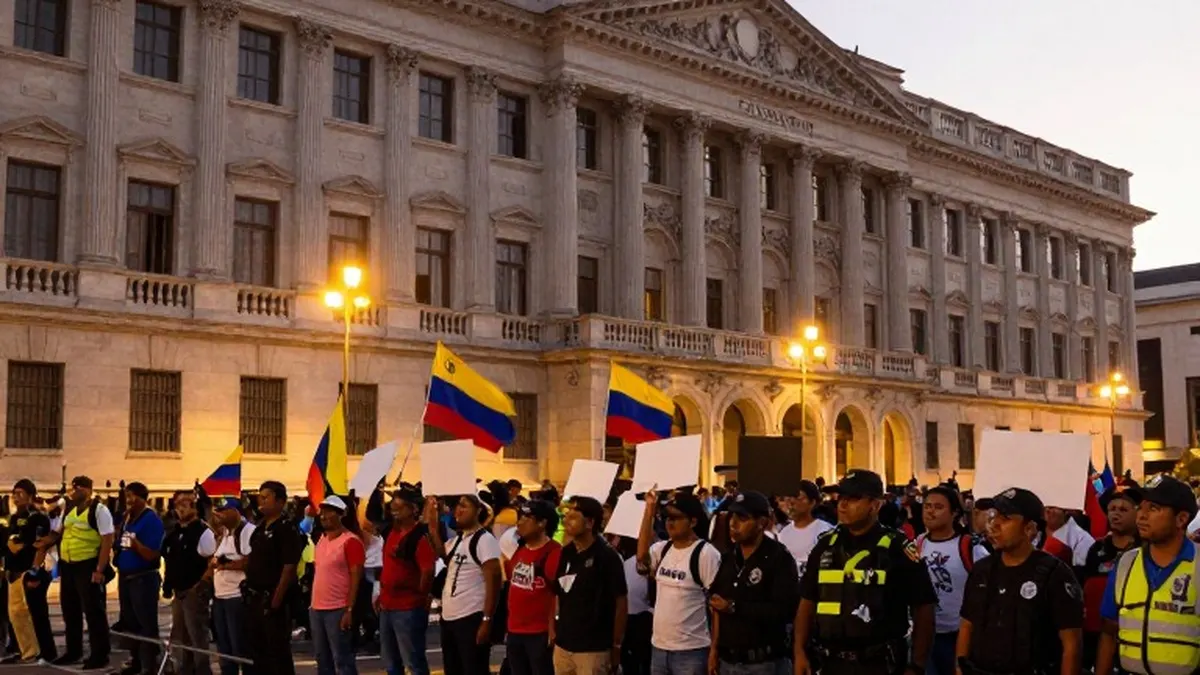
The central bank placed Ueno into resolution over insolvency last Monday, freezing the deposits of 3 million customers and leaving hundreds of thousands of families unable to pay for food and basic daily needs. Bank executives were arrested and huge protests filled the streets.
Peña, a 47-year-old economist who took office in August 2023 with a mandate running to 2028, was already facing impeachment proceedings with broad backing. In a video message, he said: 'With my heart set on Paraguay and with the conviction that our republic must always come before any person or circumstance, I have decided to submit my resignation as president of the republic.'
Ueno Bank started out as a finance company in the 1970s and was acquired in 2021 by Grupo Vázquez, one of the country's largest business conglomerates. In late 2023, under Peña's administration, the central bank authorized it to operate as a digital bank. The lender expanded quickly, drawing customers with generous cash-back offers on groceries and sponsoring the national football team, whose players on Wednesday published a letter demanding a 'forceful response' from the government and the justice system.
The bank ended up managing between $800 million and $850 million in deposits from state and pension entities, including retirement funds. That prompted conflict-of-interest criticism because of Peña's past shareholding ties to Ueno Holding. Peña said he had merely made an 'investment' as an economist and had disposed of all his shares, and he dismissed press reports of improper favoritism in directing public money to the bank as a 'false media campaign' meant to weaken his government.
On Wednesday, opposition legislators and members of Peña's own Colorado party filed an impeachment motion blaming him for the collapse. He had been a shareholder in the group behind the bank until early last year and had reportedly ignored warnings from the central bank and the media in recent months. Pressure mounted further on Thursday morning when former president Horacio Cartes, once his ally, publicly backed impeachment, writing that the party would not stand 'on the side of the theft of public, private and pensioners' funds.'
As lawmakers began debating the motion, Peña released his resignation video, saying he acted for 'the stability of our country, social peace and the need to preserve our democratic institutions.' He also apologized to citizens if he had failed them, adding that his priority was 'the peace of mind of Paraguayans who trusted their savings to our financial system' and that his greatest wish was that the return of those funds be guaranteed. Opposition senator Rafael Filizzola called the affair 'the biggest fraud carried out from political power in the democratic era.'
Peña, a former finance minister who promised to rebuild a 'great Paraguay,' was a close regional ally of US President Donald Trump and one of the few Latin American leaders at Trump's second inauguration. US officials, including Secretary of State Marco Rubio, repeatedly called him a 'strategic partner,' and Peña recently traveled to Washington to discuss critical minerals and economic cooperation. Neither Trump nor Rubio has commented on the resignation.
Vice President Pedro Alliana automatically takes over the presidency to serve out the constitutional term until August 2028. About an hour after Peña's announcement, the lower house unanimously approved the impeachment motion, which now passes to the senate. If it is approved there, even after his resignation, Peña would lose his senate seat and the parliamentary immunity that comes with it, exposing him to criminal proceedings in the ordinary courts.