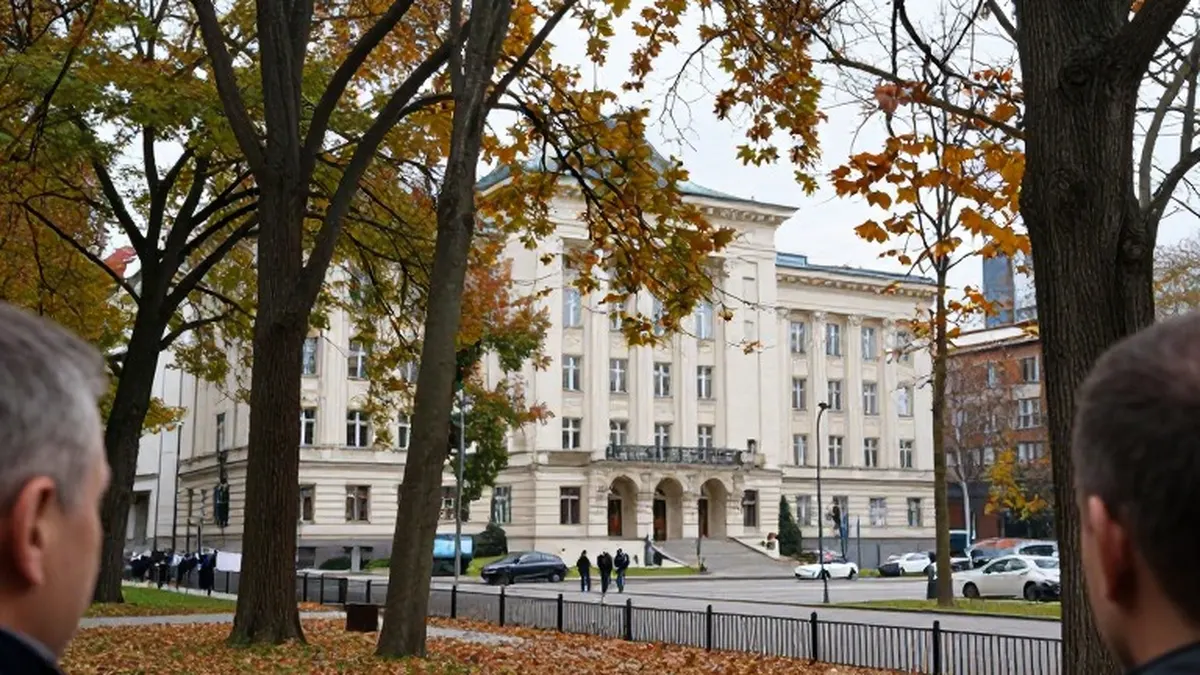
Serbia’s Student List has made tackling corruption its immediate priority after an unexpected but decisive election victory on Sunday, calling for senior security officials to leave their posts and for investigations into a deadly railway station collapse to move forward. The movement’s candidates outlined their demands on Thursday in Belgrade’s Pioneers Park, opposite the national assembly.
The announcements followed days of celebration after the direct democracy movement defeated Aleksandar Vučić and his Serbian Progressive party, known as SNS, following 14 years in government. Candidates called for the dismissal of officials including the heads of the criminal police, the paramilitary gendarmerie and an anti-terrorism unit. Candidate Svetlana Stanarević accused senior officials of breaking the law and urged the internal intelligence agency’s director to resign, alleging that he had operated it in the party’s interests.
The movement also demanded that cases concerning the Novi Sad railway station disaster be reopened or accelerated. Sunday will mark two years since a canopy collapsed at the renovated station in Serbia’s second city, killing 16 people. The disaster triggered the student protest movement, and no convictions have followed.
Iva Marković, a Student List candidate and political ecologist who founded the Right to Water initiative, said public frustration had accumulated over decades. She described the election result as an opportunity for honest public servants to work free of political pressure, with prosecutors pursuing cases and police carrying out investigations.
The transition to government will test an organisation without a conventional party hierarchy or a leader. Students chose the candidates, but will have no direct control over them once they become MPs. Marković said the shared commitments developed before the election remained important, and that keeping individual ambitions from displacing collective goals had helped the movement succeed.
Student activist Tara Blagojević said the elected candidates would now be responsible for forming a government, while student assemblies would step back into advisory or supervisory roles. She expressed confidence that the incoming MPs understood one another’s abilities and could identify suitable people for government responsibilities. Slobodan Tomić, a Belgrade-born political scientist at the University of York, also expressed optimism, noting that MPs had signed a pledge to implement the Student List’s programme.
For Borko Stefanović, who participated in the movement against Slobodan Milošević, the victory carries lessons from an earlier democratic transition whose initial promise faded. He supported removing corrupt officials and urged rapid legal accountability, stronger institutional and media freedom, and cooperation among those willing to support reform.
The celebratory mood has also reached Serbia’s cultural scene. Organisers of the Exit music festival confirmed it would return to Novi Sad next year after moving abroad this year in protest against Vučić and SNS policies. At a Fontaines DC concert at Belgrade’s port, the audience greeted the band with victory chants. Irish singer Grian Chatten congratulated the crowd and told them the moment belonged to them.