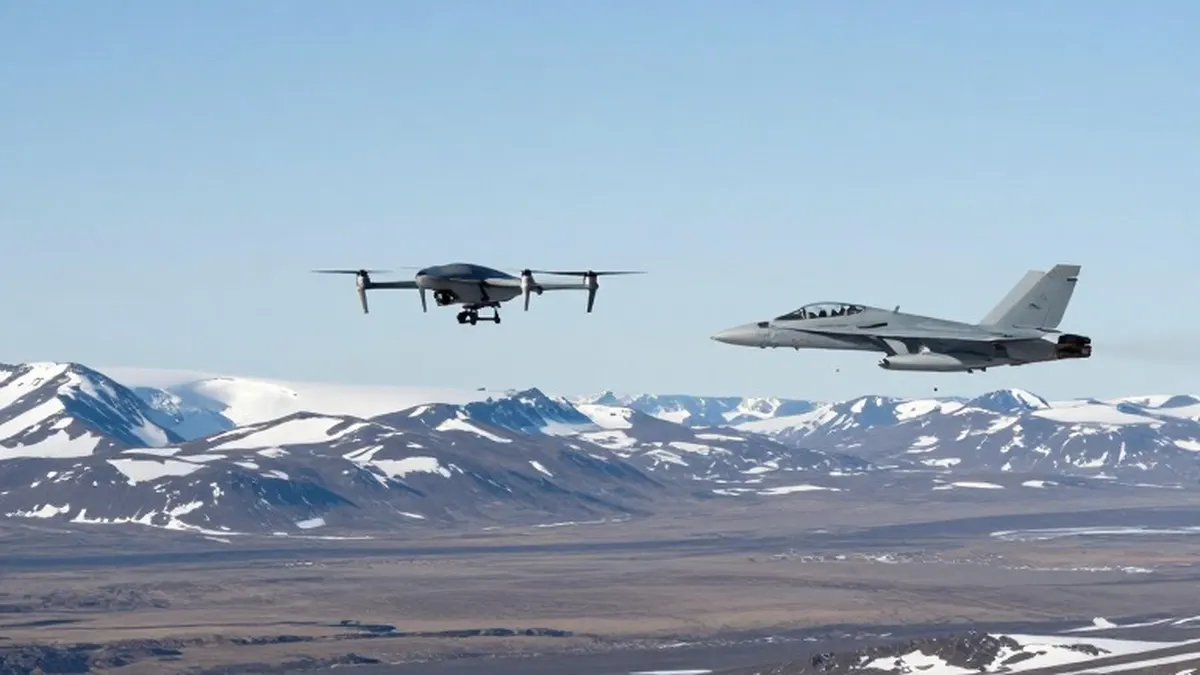
The landscape of modern warfare is shifting as artificial intelligence becomes a central component of military strategy. Recent demonstrations by American defence firms have highlighted the capabilities of autonomous systems, prompting questions about Canada’s position in the global arms race. In July, a drone developed by Anduril fired a tactical missile at a simulated target in the Mojave Desert. By October, a pilot in an F-22 fighter jet successfully directed the drone to perform simulated combat tasks, marking a significant step toward autonomous aerial warfare.
These developments involve collaborative combat aircraft, which are designed to fly alongside manned jets. The goal is to extend the reach of fighter aircraft while reducing the risk to pilots. Yvan Blondin, who commanded the Royal Canadian Air Force from 2012 to 2015, noted that these systems place artificial intelligence in deadly platforms. He believes such drones will become integral to modern militaries by the 2030s, a view shared by other Western nations that are investing heavily in autonomous systems.
Canada currently faces a strategic dilemma regarding its defence posture. The Department of National Defence stated that the Royal Canadian Air Force is examining the utility of these systems, though no procurement decisions have been finalized. The Canadian Armed Forces support the development of autonomous functionality, provided it operates within a chain of human command and control. Officials emphasize that warfare must remain a human endeavour, with no machine or algorithm held solely responsible for complying with international humanitarian law.
Domestic industry is also pushing for a role in this emerging sector. Dominion Dynamics, a Canadian defence technology company, is developing a collaborative combat aircraft called Scout. CEO Eliot Pence, a former Anduril employee, argues that autonomous systems are essential for sovereignty, particularly over the Arctic region. Given that the Arctic covers about 40 per cent of Canada, Pence contends that the country lacks sufficient fighter jets to cover the territory effectively. He believes pairing manned jets with autonomous drones is the most efficient way to close the gap in intelligence and surveillance capabilities.
Dominion Dynamics has raised roughly a third of the 500 million dollars required to build a prototype, despite not yet having a government contract for that specific project. Pence stated that the company intends to build the prototype regardless of immediate government purchases. The design envisions three or four drones flying ahead of a crewed fighter, beyond the reach of enemy radar, capable of firing weapons like missiles.
However, significant technical challenges remain regarding how these systems will interact with human pilots. Benoit Breault, senior vice-president for aerospace engineering at Dominion, explained that the company is building safeguards to ensure a human remains the final decision-maker. While straightforward boundaries, such as requiring human approval for the use of force, are clear, other aspects are more complex. For instance, determining the safest return route for a drone requires careful consideration to avoid dangerous environments or contested airspace.
Another critical issue is preventing information overload for the pilot. With multiple drones providing data, maintaining control could become difficult. Breault acknowledged that the development of the human-machine interface is still in an embryonic stage. Engineers are working to determine how decision recommendations will be displayed and how information will be provided to pilots to ensure effective command.
Legal experts are closely watching these developments. Craig Martin, a former Canadian navy officer and expert in armed conflict laws, described the extent of human control over autonomous weapons as the million dollar question. He is concerned about automation bias, where humans may over-trust machine recommendations, especially during time-sensitive engagements. Martin also warned that AI systems trained in one environment, such as Afghanistan, may make errors if deployed in a different setting, like Ukraine, potentially leading to unintended consequences.
International efforts to regulate these weapons are underway. UN Secretary-General Antonio Guterres has called for a legally binding treaty on autonomous weapons by the end of 2026. This push follows reports of a Russian drone killing three civilians in Ukraine in August, an incident that highlighted the risks of unmanned systems. Diplomats are set to meet in Geneva to discuss whether to enter negotiations on rules governing these weapons.
Canada voted in favor of a 2025 UN resolution calling for groundwork toward a treaty on lethal autonomous weapons systems. As the country commits to increasing defence spending to five per cent of GDP by 2035, the debate over autonomous weapons is likely to intensify. Blondin emphasized that these systems are coming regardless of Canada’s current decisions, making it a discussion the society needs to have now.