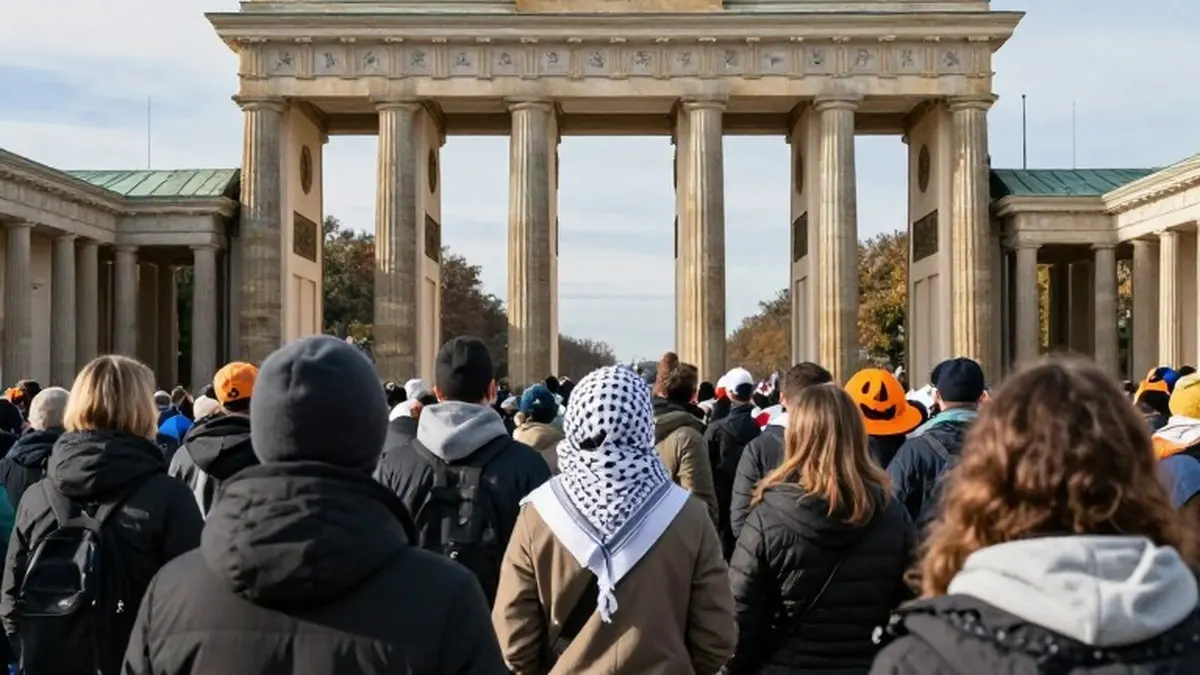
Thousands gathered in Berlin and more than 30 other German cities on Saturday as protests over pressures facing young people reached Germany amid a wider wave of student demonstrations across Europe. Rising living costs, cuts to education and military conscription were among six issues highlighted by organisers.
The loose alliance Gen Z Regelt, whose name means Gen Z sorts it, said nearly 180,000 people had registered across 34 cities by Saturday morning. Berlin, Frankfurt, Cologne and Munich were among the main locations. Almost 12,000 had signed up for the Berlin protest, with people continuing to arrive after the demonstration began.
In the capital, demonstrators assembled at Platz des 18 Maerz, west of the Brandenburg Gate, on a sunny, cold afternoon. The crowd brought together students in Halloween costumes, anti-fascist activists wearing keffiyehs and older women displaying badges identifying them as grandmothers against the right. The gathering remained calm during the afternoon, while in Cologne, protesters and police scuffled as officers moved to contain a march.
Students interviewed by Al Jazeera described frustration with funding cuts alongside heavy government spending on the military. Veronika Dinter, a 23-year-old political science student who travelled from Hannover on Friday night, said living expenses had forced her to work part-time to support her studies. She described universities struggling, institutes closing, teachers losing jobs and deteriorating educational facilities, blaming the government for the situation.
Dinter criticised Chancellor Friedrich Merz over the allocation of billions of euros to the military while education and social services faced cuts. Emma Heymann, a 24-year-old student in Berlin, expressed similar anger, saying government decisions were damaging her generation’s quality of life. She also criticised military spending and what she described as funding genocide in Gaza.
For some participants, the gathering offered a chance to connect with others facing similar concerns. Phil Tziartzianis travelled eight hours from Kassel to attend with his friend Jan Chrominski. “It feels important for me to be here among other young people who feel the same way,” he told Al Jazeera.
Recent protests in France, Belgium, Italy, Spain and Serbia had also given German students a sense of hope. Kilian Hampel, a senior research fellow at the University of Konstanz’s Future of Work Lab, said frustration had accumulated over years, while demonstrations elsewhere were encouraging young Germans to bring their concerns into public view. He said many of those concerns, particularly about inadequate educational infrastructure, were legitimate and deserved attention.
The Berlin rally was expected to run for two hours, with another demonstration scheduled elsewhere in the capital at 5:30pm. Political figures had voiced fears of violence during the preceding week, but protesters argued that such discussion diverted attention from their demands. Dinter urged police to avoid violence and expressed solidarity with people seeking affordable living, greater education investment and opposition to wars and military expansion.