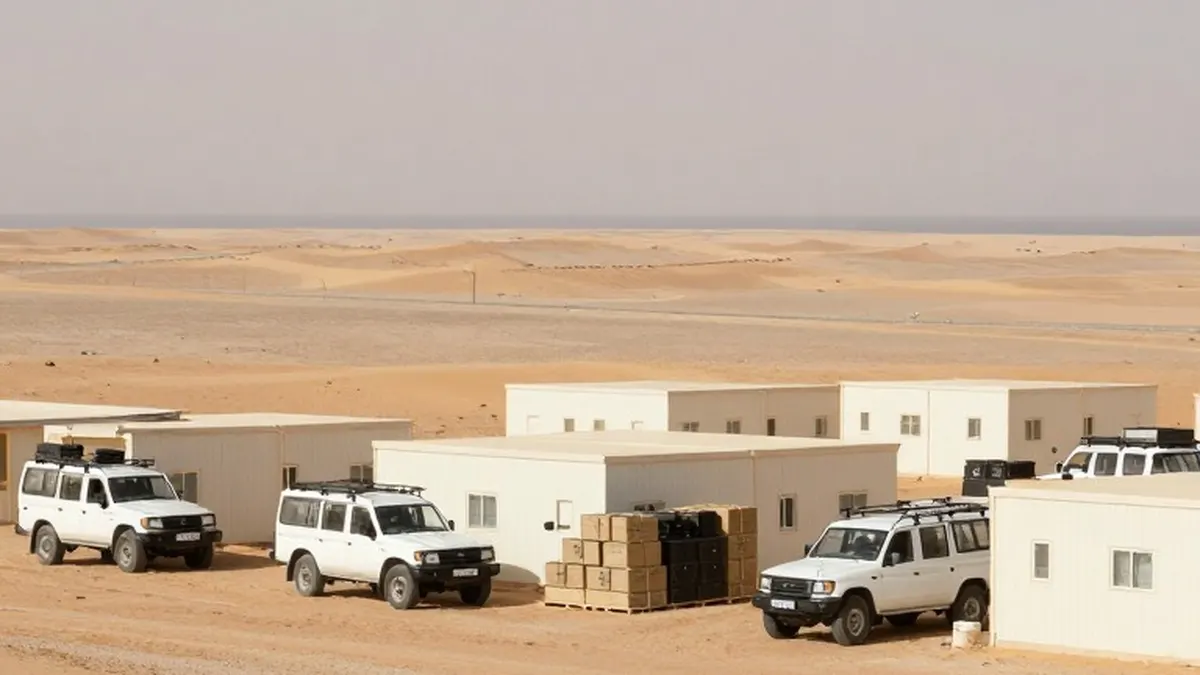
The United Nations peacekeeping operation in Western Sahara stopped work on Sunday, Nov. 1, after a confrontation between the United States and Russia prevented the renewal of its mandate. Its closure after 35 years has raised concerns about security in the territory, which is claimed by Morocco and the pro-independence Polisario Front.
The impasse followed two unsuccessful resolutions at the U.N. Security Council on Friday. Russia vetoed a U.S. proposal that would have backed Moroccan sovereignty over Western Sahara and brought the mission to an end next year. A competing Russian proposal to prolong the operation was then defeated, leaving the force without an extension. U.N. spokesperson Stéphane Dujarric said a smaller team would oversee the return of assets to countries that supplied troops and the disposal of U.N. equipment during the liquidation period.
Morocco's royal palace welcomed the outcome, describing the mission as an “instrument to internationalize the dispute.” The Algeria-backed Polisario Front condemned the closure as “an unacceptable decision.” Algeria's foreign ministry expressed deep regret over the failure to renew the mandate and accused the U.S. proposal of “excessive bias.”
Western Sahara, a former Spanish possession on Africa's northwestern Atlantic coast, has substantial mineral and fisheries resources and covers an area roughly equivalent to Colorado. The U.N. lists it as a non-self-governing territory. Morocco administers almost all of it, apart from a narrow area east of a sand wall built by Morocco. Critics of Moroccan control call Western Sahara Africa's last colony. Following Morocco's annexation in 1975, the conflict developed into a war lasting more than 15 years that killed over 16,000 people on both sides, according to the French Senate.
Securing full sovereignty over the territory has shaped Moroccan foreign policy for decades. Morocco calls the area its southern provinces and frequently judges diplomatic relationships by other countries' positions on the dispute. Its stance has gained support from an increasing number of Western capitals, including Washington, Paris and London. The Polisario Front seeks an independent Sahrawi Republic in what it regards as the homeland of the Indigenous Sahrawi people. Based in refugee camps in Tindouf, Algeria, it relies mainly on Algeria, Russia and South Africa, although its international backing has diminished in recent years.
The peacekeeping mission, known as MINURSO, was created following a U.N.-brokered cease-fire in 1991. The settlement envisaged a referendum on self-determination that would include independence as an option, but disagreements over voter eligibility prevented the ballot. Morocco sought to include Sahrawis living in areas under its control. Polisario argued that this would favor integration with Morocco and demanded that eligibility be based on Spain's colonial census.
Twenty members of MINURSO died during its deployment. The force had authorization for 534 personnel and a budget exceeding $62 million for 2026-2027. Egypt, Ghana and Pakistan were its largest military contributors. Through Dujarric, the U.N. secretary-general urged respect for the rights of Western Sahara's people and maximum restraint, expressing concern about security and the possibility of escalating hostilities.
Polisario abandoned the cease-fire in 2020 following clashes. In October, the U.N. said tensions and low-intensity fighting continued in the territory. Western Sahara remains a central source of rivalry between Morocco and Algeria, which supplies Polisario with weapons, financing and a base of operations. Algeria regards full Moroccan sovereignty as a major diplomatic defeat. The neighbors broke diplomatic relations in 2021, and the mission's closure risks worsening their relationship and encouraging an arms race.