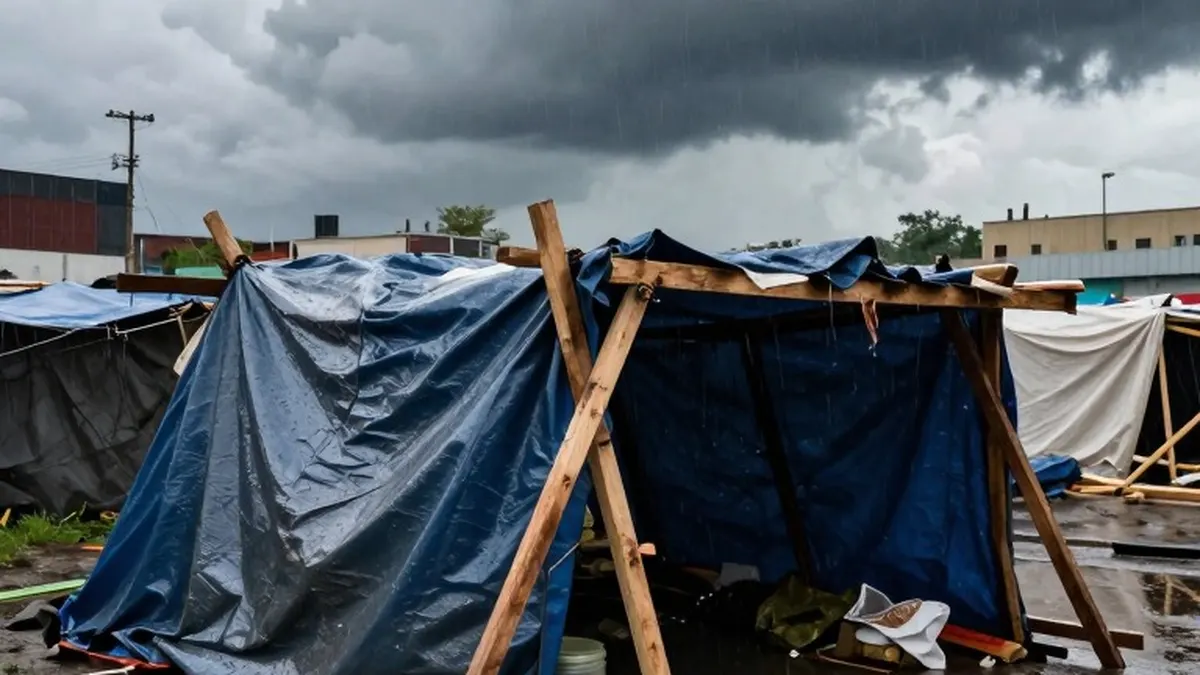
Heavy rainfall swept across the Gaza Strip on Saturday, flooding thousands of tents and makeshift shelters and leaving displaced families vulnerable to rising water and freezing temperatures. The storm has highlighted the critical vulnerability of hundreds of thousands of Palestinians living in structures that were already weakened by years of conflict and bombardment.
In the al-Tuffah neighbourhood of Gaza City, Mansour al-Sakni, a 33-year-old father of four, watched with despair as rainwater overwhelmed his family’s shelter. The family had recently sold two water barrels to purchase new tarpaulins, hoping to secure a dry and safe environment. However, the first major winter storm of the season rendered their efforts ineffective, submerging the 30 square metre room where they reside.
Sakni, who previously earned a living selling newspapers, now relies on food from community kitchens due to a lack of steady income. He noted that his 10-year-old daughter, who suffers from poor eyesight, still lacks the glasses she needs because he spent a small loan on wood to reinforce their shelter instead. A shrapnel injury sustained in 2024 further complicates his situation, as cold weather causes him significant pain in his back.
The impact of the weather was not limited to makeshift tents. In northern Gaza, Nasmeh al-Khatib, 26, and her two-year-old daughter were trapped in a partially destroyed building in Mashrou Amer. The structure, which lost three of its four floors in an October 2025 strike, now houses five families. Strong winds tore away the tarpaulins covering the openings, allowing water to pour inside and frightening the children who mistook thunder for explosions.
Khatib reported that the storm also caused electrical issues, with parts of the walls and floor giving shocks and cutting off power to their solar panels. Despite their attempts to seal holes in the walls and secure the coverings, the family felt that their efforts were futile against the persistent flooding.
Gaza’s Civil Defence agency reported receiving approximately 1,500 distress calls within ten hours of the rain beginning. Spokesperson Mahmoud Basal stated that several shelter centres were completely flooded, forcing residents to evacuate into the unknown. At some locations, water levels rose by 30 to 40 centimetres, posing significant risks to the structural integrity of the buildings.
The United Nations Office for the Coordination of Humanitarian Affairs reported on November 5 that the territory still requires around 121,000 tents and 561,000 tarpaulins. As of November 1, available stocks were limited to about 2,800 tents and 76,000 tarpaulins, with no emergency shelter kits in inventory. The agency warned that delays in approvals and funding shortages could prevent some materials from arriving until the second half of winter.
Further complicating the crisis, Israeli authorities have continued to reject the entry of timber needed for shelter kits. The Norwegian Refugee Council noted in October that these restrictions and funding gaps are likely to leave 1.65 million people facing a fourth winter in worn-out conditions. Additionally, an estimated 950,000 people are living in displacement sites with medium to high flood risks.
Civil Defence officials have stated that their response capabilities are severely constrained by a lack of equipment. Raed al-Dahshan, the director of Civil Defence in Gaza governorate, revealed that the agency did not have a single tent or tarpaulin to distribute to affected families. The latest storm also resulted in the evacuation of residents from a partially collapsed building in Nuseirat and left two people injured in northern Gaza.
For families like those of Sakni and Khatib, the challenge is not merely the arrival of winter rain, but the absence of a safe place to shelter from it. Sakni expressed his fatigue with their current living conditions, calling on the world to find a solution for the displaced population.