China has been conducting major military exercises around Taiwan since early November 2026. Despite widespread claims on social media suggesting a full blockade of the island, Beijing’s armed forces have only simulated such a restriction rather than implementing it in reality.
Viral posts on the platform X, including one from November 5, featured animated maps depicting an annexation of the island. These visuals showed dozens of Chinese aircraft and naval ships encircling Taiwan to isolate it from air and sea routes. The posts, which also highlighted two Chinese aircraft carriers, the Fujian and the Liaoning, garnered hundreds of thousands of views. However, analysts argue that this interpretation of the People’s Liberation Army’s maneuvers is misleading.
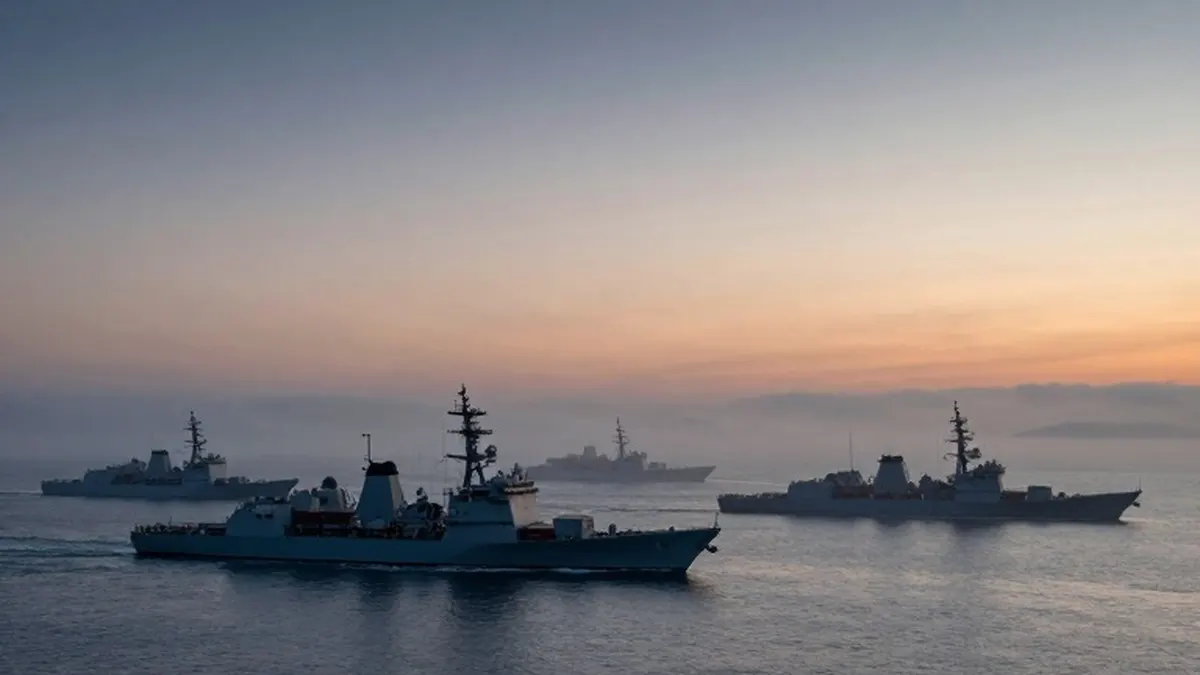
The deployment of military assets was indeed significant. On November 3, Joseph Wu, the secretary general of Taiwan’s National Security Council, reported that 100 ships from the Chinese navy and coast guard were present in the western Pacific. On the same day, Taipei's Ministry of National Defence detected 49 Chinese military aircraft near Taiwan.
Emmanuel Véron, an associate researcher in the geopolitics department at HEC Paris, described the claim of an actual blockade as absolutely false. He noted that such assertions are either exaggerations by social media influencers or Chinese propaganda intended to project control over the island. Véron also pointed out that the account Fablex, which shared the viral map, had biographical inconsistencies, such as claiming to be based in both California and Uganda, suggesting it may be a clickbait account designed to drive views.
Recent data indicates a potential wind-down of the operations. Between November 8 and 9, the Taiwanese Ministry of National Defence counted only one Chinese aircraft north of Taiwan, a significant drop from the 49 recorded on November 3. Additionally, just eight Chinese ships were spotted near the island during that period. Véron noted that eight ships are insufficient to organize a blockade, suggesting the operations may be concluding.
Civilian shipping has continued to move around Taiwan during the exercises. According to the tracking service MarineTraffic, the container ship One Hanoi departed from the port of Kaohsiung on November 3 and entered the Taiwan Strait. This occurred during the height of the military operations, demonstrating that maritime traffic was not fully halted.
The strategic goal of these maneuvers appears to involve communication management. Unlike last year's drills, Chinese authorities did not announce the operations in advance. Véron suggested that Beijing may be remaining discreet ahead of the APEC summit scheduled for November 18 in China, or they may choose to make announcements only after the exercises are complete.
The scale of the current operations is unprecedented. Véron described a gigantic naval operation involving multiple branches of the army, including the navy, coast guard, and auxiliary fishing ships. For the first time, these exercises have taken place across multiple fronts, including the north, south, and center of the island, rather than primarily on the side facing China.
A map shared by the Institute for the Study of War showed that on November 3, the Chinese navy was deployed not only around Taiwan but also in the South China Sea, the East China Sea, and the Philippine Sea. This broad geographic presence highlights the extensive nature of the mobilization.
Experts emphasize that the size of the operations does not signal an imminent invasion. Véron explained that this is a training exercise conducted in real geographic and operational conditions. The primary aims are to train troops, test capabilities, and exert pressure on the Taiwanese government and its allies, continuing a long-standing pattern of pressure from China.