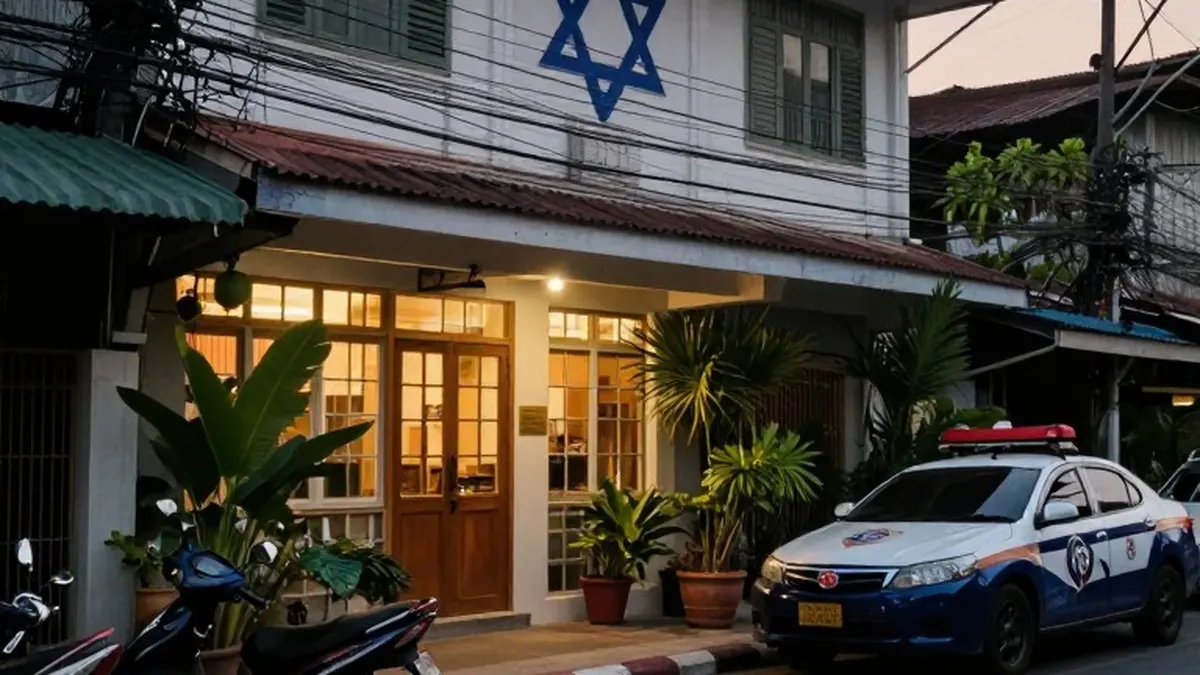
For decades, Israel's relationship with Thailand has been described as a love affair. More than 400,000 Israelis are expected to visit the Southeast Asian kingdom this year, and about 10,000 Israelis live there permanently. The affection has run both ways: around 60,000 Thai workers are currently employed in Israel, an all-time high and twice the number from before October 7, 2023.
Over the past three years, and particularly in the past year, the tolerance long associated with Thai society has shown signs of wearing thin. Amid a global rise in antisemitism and domestic political pressures, reports have mounted of selective and excessive enforcement against Israeli tourists and against the Jewish and Israeli presence in the country.
The shift has unfolded in stages. In January 2024, six members of the Russian rock band Bi-2, including three Israelis, were arrested in Phuket over allegations of performing without work permits and narrowly avoided deportation to Russia. In 2025, four Israelis were arrested after a disturbance at a hospital in Pai, an incident that ended in fines and deportation proceedings. In October of that year, an enforcement sweep on the island of Koh Phangan targeting unauthorized work, visa overstays and real estate activity prompted local protests against the island's transformation into an Israeli enclave.
Enforcement widened this year. In April, three Israeli women were arrested in raids on two daycare centers on Koh Phangan over alleged licensing and labor violations. On September 15, four bodies, including those of three Israelis, were exhumed from a Jewish cemetery whose license had expired. Two days later, a report circulated, later officially denied, that Prime Minister and Interior Minister Anutin Charnvirakul had said of foreigners seeking private houses of worship and cemeteries: "If you are going to die, go die in your own country."
In October, authorities revoked the longstanding Thai citizenship of Ariel Blushstein over his use of an Israeli passport and an allegation that he concealed an additional nationality. Then came the biggest shock: the revocation of the citizenship of Chief Rabbi Yosef Chaim Kantor.
Kantor, 56, a father of eight, is the chief rabbi of Thailand's Jewish community, the chief Chabad emissary in the kingdom and the founder of Bangkok's kosher certification board. He arrived in Bangkok in 1993, built a network of six Chabad centers, and took a leading role in the humanitarian response to the 2004 tsunami. He was granted Thai citizenship in 2013 after two decades of community service. The official explanation for the revocation was bureaucratic: he allegedly used his American passport when entering and leaving Australia, violating his naturalization terms. The practice is common among tens of thousands of dual nationals in Thailand, and Kantor, an American citizen who grew up in Australia, does not hold an Israeli passport.
The decision comes amid a growing street and social media campaign. Recent months have seen explicitly anti-Israel and antisemitic demonstrations, including outside the Israeli Embassy in Bangkok and in Phuket, where protests led to the cancellation of the traditional Rosh Hashanah evening meal at the local Chabad House. Leading the campaign is Sondhi Limthongkul, a media tycoon and former leader of the Yellow Shirt movement, who led the September embassy demonstration where signs included "Death to Jews" and spoke at a rally in Phuket last Saturday. He has demanded investigations into Chabad's activities, claimed Rabbi Kantor sits at the center of a business network worth tens of billions of baht, alleged Chabad raised more than $30 million to build a large new synagogue, and called for restricting Israelis to a single 15-day visit.
Rabbi Nechemya Wilhelm, a longtime Chabad emissary in Bangkok, said two parallel processes are at work: a year of relentless media incitement that his community believes is fueled and financed from abroad, and stepped-up government enforcement that has placed a heavy emphasis on Israelis. He said authorities "have made Chabad a test case to demonstrate a tough approach," noting that tens of thousands of Thais hold two nationalities without facing such action. Chabad operates six centers in Thailand with 14 emissaries and their families, he said, adding: "The revocation of Rabbi Kantor's status leaves all of us in question."
As a preventive measure, the Israeli Embassy has issued conduct guidelines urging travelers to keep noise down, respect local customs, obey traffic laws, avoid visa overstays and refrain from working without permits. Ilan Dambinsky, an Israeli podcaster who divides his time between countries, recalled "a smiling Thailand, a place where people were truly happy to see tourists," but acknowledged contributing factors: excessive tourism from around the world, and the tendency of some Israelis to act as if they own the places they visit. "This change is terribly upsetting because Thailand is lovely," he said.