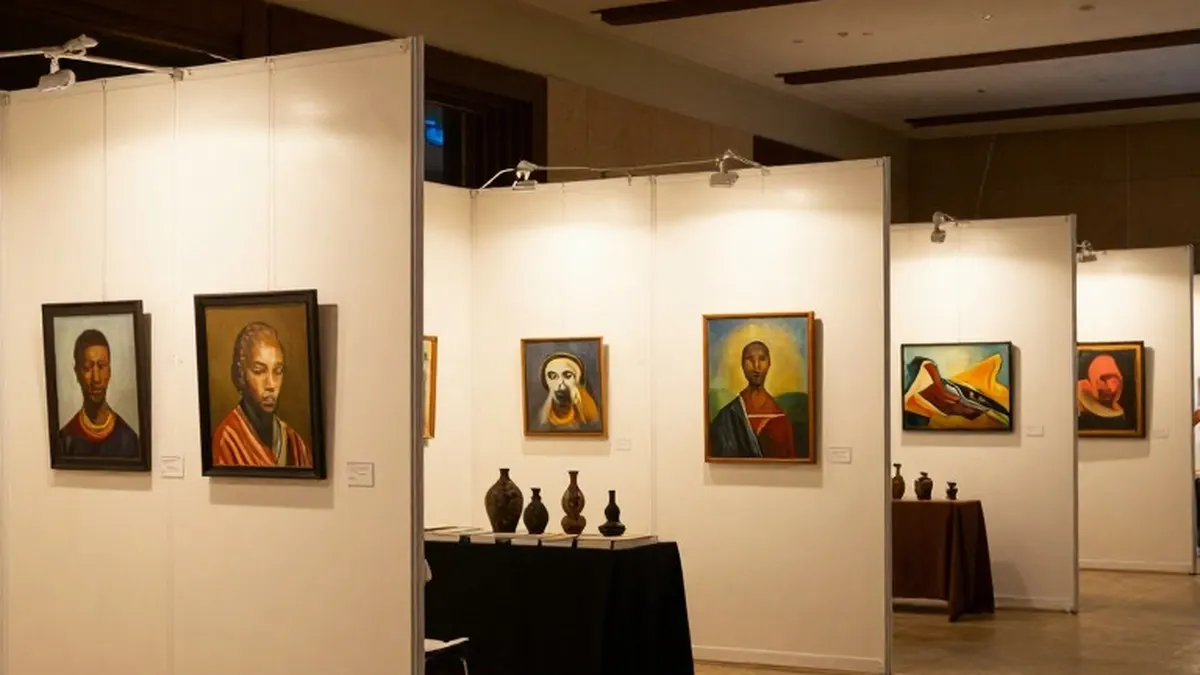
Questions of identity, displacement and belonging shaped Nigeria’s annual art week, with ART X Lagos drawing thousands of visitors to the Federal Palace Hotel on Victoria Island from November 5 to 8. The fair combined exhibitions and installations with music, discussions and film screenings, while galleries and museums elsewhere in Lagos hosted their own presentations.
Now in its 11th edition, the fair adopted the theme “A New Chapter, A New Decade”, taking inspiration from artists, architects, educators and thinkers who helped establish Nigerian modernism. Founder Tokini Peterside said their example showed how cultural inheritance could inform innovation. Across 15 partitioned exhibition spaces, the programme explored how creative work can preserve shared memories and strengthen connections with heritage.
In Residues of Past Encounters II, sculptor and multidisciplinary artist Ndidi Dike suspended a wooden canoe above glass, surrounded its edges with sand and hung Adire-style fabric bearing silhouettes of closely packed people overhead. Sand and recordings of waves came from Badagry, a Nigerian coastal town that served as a transit point for enslaved West Africans. The installation connected the slave trade and colonialism with questions of memory and migration.
Dike also drew parallels between historical displacement and the dangerous journeys young Africans continue to make towards Europe through the Sahara Desert and across the Mediterranean Sea. Some travellers die, while others encounter trafficking and exploitation. She said the installation’s sounds encouraged visitors to consider the feelings of people leaving home without knowing whether they would return.
Another exhibition, Beyond the Vessel, celebrated Nigerian potter and ceramicist Ladi Kwali. Her handmade works featured animal motifs, including scorpions, lizards and butterflies, alongside detailed patterns. Raised among generations of Gbari women potters in Kwali village near Abuja, she gained international recognition, with works entering museum and gallery collections and her portrait appearing on Nigerian currency. Curator Jareh Das said protecting that legacy could inspire younger artists amid challenges in documenting and maintaining cultural heritage.
Access for young audiences was another focus. More than 750 schoolchildren attended the fair’s educational programme, encountering contemporary artworks and the stories behind them. Peterside said such experiences could help children recognise creativity as something they could take part in. Personal recovery also found expression in Adeniyi Adewole’s fibreglass sculpture Breath Beneath the Waters, which reflected his return to work after depression had left him unable to create for a period.
Beyond the fair, Mercy Imiegha’s group exhibition Every House Remembers brought together four artists examining how domestic spaces, objects and bodies retain history, memory and spiritual identity. The Nigerian-founded Guest Artists Space Foundation also organised an art tour across the city, extending opportunities to encounter the programme throughout Lagos.
Loss and remembrance were central to Joel Benson’s feature-length documentary Mothers of Chibok. It followed three parents and a woman who was abducted and later freed after Boko Haram kidnapped 276 schoolgirls from their Chibok dormitory in 2014. Amnesty International reported in April 2024 that 82 remained captive. Benson described families continuing through grief with humour, tears and faith, and said he hoped the film would encourage action on policy and security.
Alongside these reflections, the fair provided space for visitors to meet, collect art and exchange ideas. Attendees browsed books, discussed exhibitions and gathered in the outdoor cafe area. Peterside said she hoped they would leave with a fuller appreciation of artistic expression from Africa and its diaspora, and an interest in exploring the histories and perspectives presented.