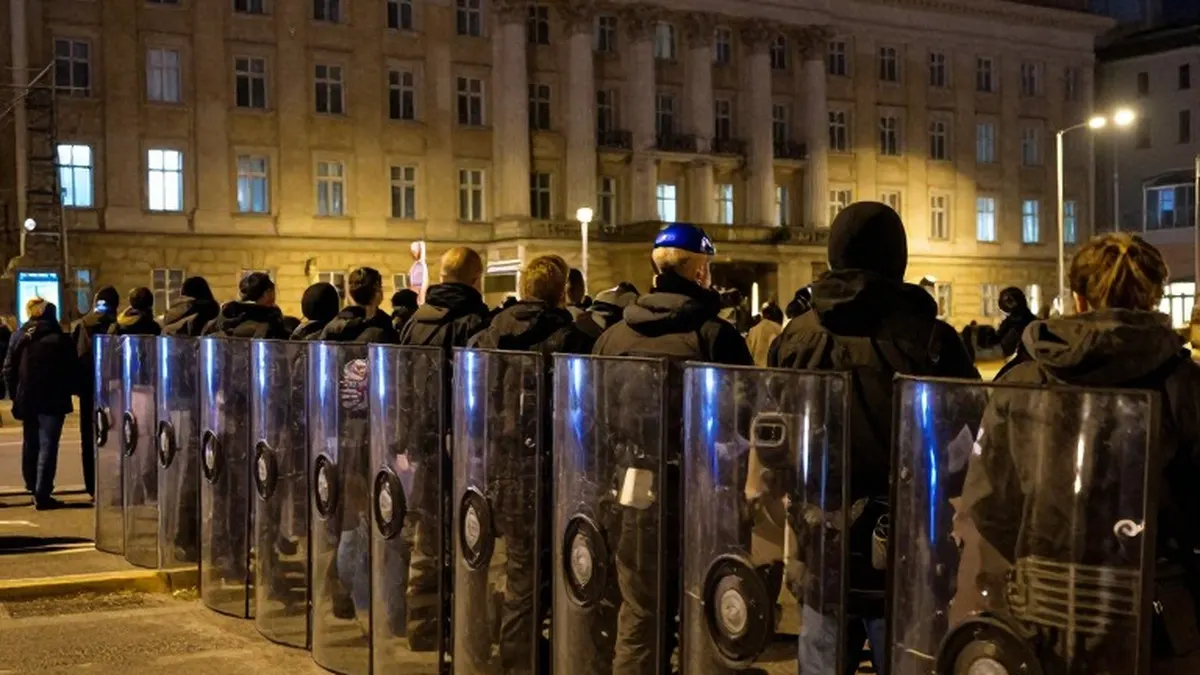
Riot police were deployed outside Poland’s Constitutional Tribunal in Warsaw as hundreds of protesters gathered on Friday night following the announced suspension of its president and deputy. The confrontation intensified a dispute between Prime Minister Donald Tusk’s government and the opposition Law and Justice party, known as PiS, over the court’s membership and legitimacy.
President Karol Nawrocki, a PiS ally, cut short a flight to Senegal and returned to Poland, visiting the tribunal overnight. By Saturday morning, he had called urgent consultations with parliamentary representatives and characterised the events as a forcible takeover of a constitutional institution. Police reported arresting three people who tried to enter the court complex.
Judge Anna Korwin-Piotrowska announced on Friday that tribunal president Bogdan Swieczkowski and deputy Bartlomiej Sochanski were suspended for one month, saying she would take responsibility for running the court. Her authority to do so is disputed: her claim relies on her overall length of judicial service rather than the longest tenure on the tribunal. Justice Minister and Prosecutor General Waldemar Zurek separately took steps that could lead to criminal proceedings against the two men. Far-right critics described those measures as political pressure.
Senior PiS figures joined supporters outside the tribunal to oppose the suspensions. Police said they deployed after Korwin-Piotrowska provided information about potential threats to judges and employees, as well as public order risks. Officers were securing the grounds but had not entered the building, according to police. Tusk defended the action as necessary to restore the rule of law after political interference under PiS.
The tribunal determines whether legislation complies with the constitution, giving its rulings the power to block laws from taking effect. The dispute dates to 2015, when an outgoing parliament elected five judges before PiS took power. The tribunal later found only three appointments legally valid. The incoming PiS majority nevertheless selected replacements, including for those three seats, while then-President Andrzej Duda declined to swear in the validly elected judges.
Critics said judicial changes during PiS’s eight years in government increased political influence over the courts. In 2021, the European Court of Human Rights found that an improperly appointed judge’s participation had denied a company its right to a legally established tribunal. In December 2025, the EU’s highest court ruled that the tribunal failed to meet independence requirements and that its judgements challenging EU law violated Poland’s membership obligations.
Since returning as prime minister in December 2023, Tusk has sought to restore judicial independence. His government rejects the tribunal’s legitimacy in its current form and has tried to disregard its rulings. Parliament elected eight judges to the 15-member court this year. Nawrocki administered oaths to three but withheld them from five, who took their oaths without him. Swieczkowski subsequently prevented those five from adjudicating.
The government’s own appointments have also drawn criticism. Some coalition members opposed parliament’s September election of former Tusk cabinet minister Maciej Berek to the tribunal, arguing that it conflicted with pledges to remove politics from the judiciary. Lawyer Marcin Matczak told Al Jazeera that a tougher approach could mobilise frustrated government supporters ahead of next year’s parliamentary elections, while risking the loss of more moderate voters.
A judges’ meeting that Matczak said was scheduled for November 3 could become the next flashpoint. Efforts to lift immunity could deepen the conflict if the assembly’s membership or quorum is challenged. Matczak also warned that future governments could cite the confrontation as justification for using police to resolve legal disputes, with potentially damaging consequences for Poland’s institutions.